Today marks two weeks since I have arrived in St. Gallen, Switzerland. The days have been filled mostly with wandering through the city center, taste testing different delicacies, drinking an excessive amount of beer, and learning special words of the Swiss dialect each morning in German class.
Every day I discover another unique aspect of this winter wonderland. With every turn, there is one more breathtaking view of the mountains or snow-covered houses overlooking the city below. I’m almost convinced that I’m really just living in a snow globe filled with swirling snowflakes, kind people, and quaint architecture. The city emanates peace and quiet, which has allowed me to feel inevitably comfortable getting acclimated. I have learned how to use the bus system, where to shop for the cheapest groceries, and that walking around eating an abnormally large sausage is, in fact, perfectly normal. While I am fully aware that I am not a local here just yet, it is a personal accomplishment for me to say that it is starting to feel like my home away from home.
On my third day here, I woke up early after getting a full night’s sleep and found a coffee shop to sit in and read for the entire afternoon. When I sat down with my cappuccino and looked out the window at the bustling, cobblestone street outside, I became overwhelmed with joy. It was a random burst of happiness, and I think it came from the satisfaction that I had felt comfortable enough to branch off alone, find a spot for myself and do something that I love to do. I had survived the trek across seas, made friends immediately upon my arrival, and knew how to navigate the city (which is an accomplishment for someone with absolutely no sense of direction). An act as simple as reading and drinking coffee on my own felt almost euphoric.
This feeling was soon combatted with irritability and annoyance over the next few days as I began to realize that my world isn’t picture perfect. It was as if the high that came from my first week or so being in a new place was replaced with a weight of volatile negativity, and it was somewhat sobering. I didn’t necessarily feel angry, but I did feel underwhelmed with my surroundings for the first time.
Nothing traumatizing had happened to me, but there were a couple blunders that led to bad days that led me to continuously resisting those negative emotions because I was frustrated for feeling them in the first place. On the upside, these were ideal opportunities for me to practice being aware of my emotions and accepting them. Living in the moment, one of my goals for the semester, is a very effective way to get out of one’s mind and escape that irritation. A friend who had studied abroad previously had told me before I left for this semester that it was okay to have bad days or days that seemed imperfect, and she’s right.
As I have observed my emotions and instinctive tendencies over the last two weeks, I have been asking myself the same question: What is happiness? Did I really feel a wave of it sitting in that coffee shop or was that just some form of self-gratification? I think if I could answer the first question, I would use a variety of emotional descriptions and past experiences, but it is more difficult to really define the moment of knowing the essence of pure happiness.
To find some insight and enlighten my curiosity, I started a new book called Ikigai: The Japanese Secret to a Long and Happy Life written by Héctor García and Francesc Miralles. “Ikigai” translates into the purpose for living, and according to this Japanese concept, happiness and longevity are directly related to one’s reason for being or the meaning of one’s life. I have now realized that the difficult part of happiness is not in defining it, but it is in the mission of legitimately finding one’s own purpose. Shown below is a diagram that represents the components of finding the coveted ikigai through our every day lives.
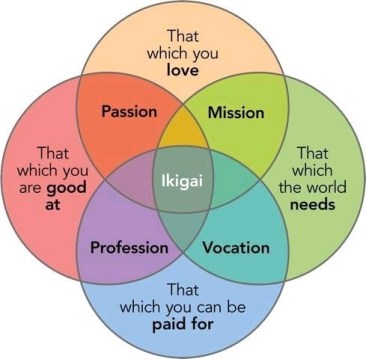
When I first saw this chart, my reaction was how can finding the meaning of life be that simple? The more I read, the more I learned that there are many complex practices that lead to discovering one’s purpose. For example, one must find balance and have a present mindset, or “flow”, which it is referred to in this book. Coincidentally, these are two concepts to which I have dedicated a lot of time and thought in order to positively alter my life for a better future. One must find flow in tasks being done daily, eat healthily and exercise, and learn not to give in when difficulties arise.
Another key aspect to eternal happiness is what the Japanese call “moai”, or an informal group of people with common interests who look out for one another. Friendship. I wanted to shed light to this specific component because it has always been a vital part of my life and, most recently, has single-handedly allowed me to have an overall positive experience since I have been in Switzerland.
Upon my arrival, I met two other students from USC who came to St. Gallen as best friends. I have not connected more with two individuals in such a short amount of time than I think maybe ever, and that is due to their captivating transparency, unwavering desire to laugh and have fun, and ultimate source of compassion. I am more than lucky to have met these people already, and I know that they will be two of my best friends by the time I leave here.
Although the details of each person’s moai vary according to the group, the feeling of belonging and support gives an individual a sense of security and helps increase life expectancy according to the Japanese concept. Not only do I have my two partners in crime by my side, but I have also met incredible people from all over the world who I have connected and shared humor with since I have arrived. While I am fully aware that finding my purpose will be challenging, I am more than confident that I have the support system to do so here in Switzerland and back at home.
Previously, I have spoken greatly to why being pushed out of my comfort zone is a necessary step towards becoming the person I want to be, and I think that the initial discontentment of being here made me question if feeling happy was even possible. While that sounds relatively morbid, I think it is the perfect example of how I’m learning about myself. It has been two weeks and I already have a mission to find the purpose of life. I may be the walking example of the classic cliché “college student who goes to another country and finds oneself”, but at the end of the day, I am perfectly happy to come back from this trip with a higher life expectancy and the ability to feel joy.
Do I know how to find my ikigai? Absolutely not, but I am learning. If you can’t tell by now, that seems to be the theme of the semester. I have been asked before in interviews about my long-term goals, and in preparation, I have always asked myself, what is my ultimate goal? Every time I answer, “to be the best version of myself.” To be honest, I’m still figuring out what that best version looks like entirely.
Who is this version? She is most definitely a voracious reader, a lover of learning, and a teacher. She’s a musician, an artist, and an exceedingly expressive writer. At times, she is a compassionate therapist and listener. She is a helper and a philanthropist. She is, without a doubt, a world traveler, and she could very well be an investment banker. While I may not know exactly how to get to where I want to be, I know that I have many different passions that will lead me to find my existential fuel, and for that I am grateful.
 Fondue Me